Tuesday, February 12, 2013

The Jaipur jostle

Well, as predicted the flight from Udaipur to Delhi, didn't materialise and we were forced to cancel our flight and jump a car on a marathon 7 hour highway journey - which to say was hair-raising would be quite an understatement.

If you don't believe me - check this out: http://www.youtube.com/watch?v=cNR0IvK46DI.

We did arrive in Jaipur in one piece and after an equally manic drive through the city centre, we arrived at our sanctuary of Disney-esque tranquility, otherwise known as the Oberoi Rajvillas.  It felt quite surreal in this peacock-plastic-paradise.  But a welcome respite from the crazy Indian roads, nonetheless.  We ate quickly and retired early.

Up the next morning with a packed schedule; we'd lost a good half day with the flight fiasco, but were determined to cram as much of Jaipur in as possible.

Sun dial - Jaipur-style
Our driver and guide dutifully whisked us off to the jantar mantar an expansive astrological playset of instruments built by Jai Singh II in the early 18th century.  The accuracy of these enormous tools was impressive: we walked 30m from one to the next and discovered the latter was calibrated 2 seconds behind the former in order to allow for the correct Jaipur-time.


The Royals still live here....all 5 of them...
Jaipur palace
Time marched on (no pun intended): we sped to the city palace adorned with fabrics from kings of old, peacock painted portals, (enough of p-alliteration for now, methinks) and airy courtyards.  The princely yellow was in stark contrast to the commoner red of outside.

But one of our holiday highlights waited still to be witnessed.

Amber fort
Perched on a hillside and constructed way back in the 16th century with various additions after that, the yellow golden edifice is almost climbing down the hillside and dipping its toe in the lake below.  It creeps almost in its majesty.  Courtyard after courtyard we visited and thus to the inner sanctum, where the king kept his harem of hundreds of perhaps-not-so-willing concubines.

Ingenious water channels kept the place coolish in summer and a myriad of defence mechanisms helped keep the place free of storming.  It was like visiting the Alhambra of the east - awesome in detail, magnificent in imposing stature.


Hair cut anyone?


Palace dome detail


A quick photo-op at both the Water Palace and Wind Palace and we were done.  We needed to get on the highway (again) and zip to Ranthambore for the safari that was prescient with tiger-sightings.  How disappointed I was about to be...

Wind Palace
Water Palace

Sunday, February 10, 2013

Udaipur - a golden city

Leaving the grandeur and shiny splendour of Indira Ghandi Airport in Delhi, we weren’t quite sure what to expect in the provincial city of Udaipur.  But with a porter to greet us and a speedy exit on the conveyor belt of our luggage, we were soon whisked off in a slick black Jaguar and on our way to the Taj Lake Palace.
 
Taj Lake Palace Hotel
We cruised through villages and hamlets, each adorned with a colourful array of Hindi hand-written signs.  The colours jumping out like 3D bill boards; yellow, orange, red, ochre, blue – the entire rainbow.
 
Hotel jetty
The city itself is not too big at about 500 000 inhabitants, but the usual cacophony of horn hooting greeted us on the city limits.  Closing our ears, and eyes sometimes, our driver navigated with skill the chaotic roundabouts and half-observed T-junctions and miraculously got us to the hotel jetty on the edge of lake Picholi in one piece.  


Udaipur City Palace
The golden sun was about 20 minutes away from setting and the glow bounced off the city palace behind us, rendering the peeling plaster resplendent and shimmering.  The entire lake was imbued with a picture-postcard atmosphere and as we donned our obligatory life jackets for the short ferry transfer to the hotel, I took a deep breath and pinched myself to confirm I was actually here in the land of the maharanas and maharanis and about to tread in the footsteps of Rajasthani royalty.
 
The palace, which is now the Taj hotel on the glass-like lake, was built by a former maharana in the late 18th century – it was to complement their winter palace, just on the lake edge, and the lofty monsoon palace perched high on a distant hill – well away from torrential downpours.
 
We stepped off the barge and were escorted by the hotel doorman under a royal parasol to the triple doorway – common in Hindu culture – and were suddenly and surprisingly showered with rose petals from the balcony above.  As they fluttered down the air was filled with their exquisite scent and for a moment, just a moment, I felt I could “eat” the air.  I was beginning to feel like royalty indeed.
Rose petals fluttering earthwards
 
The hotel was updated in the 70s by the Taj group after the local royals gave up trying to make it a going hospitality concern – and the “facelift” they gave has been incredibly true to the original palace principles and layout.  The charming lobby lead to a first courtyard where nightly performances of local dancing were given – complete with resident fortune teller.  (The latter, seemed to be sitting alone for most of the time and I couldn’t help wondering, if he is indeed a fortune teller, why he couldn’t predict when the next customer was coming and save himself the apparent boredom of sitting palm-less for hours on end.)
 
The inner courtyard had a magnificent waterscape in the middle, in the shape of a lily flower; adorned with flowers and tea lights, the view was perfect.
Inner courtyard at Taj Lake Palace Hotel
 
We slept quite early but not before sampling the Indian cuisine in the hotel restaurant.  Shafiq was our waiter and very attentive he was too; suggesting dishes, and combinations and generally being a shadow to our dining.  Slumber came quickly as we watched the moon rise over the city palace across the lake from our bedroom window; I fell asleep thankful and feeling very lucky.
 
Dome detail at City Palace
The next day we headed out after a sumptuous breakfast to the city palace and the adjoining museum.  It was filled to overflowing with miniature paintings, furniture from bygone kings and intricate finishes.  The palace is actually built atop a series of small hills, so even thought it looks massive on the outside, the useable space on the inside is limited and the resulting warren of passages makes for an interesting ducking and diving kind of tour.  After a few expensive pashmina-type purchases, we strolled in lush public gardens, watched the mastery of miniature-painting artists at work and then headed back to the hotel.
 
Baxter had arranged a splendid private dinner on the Mewar Terrace in the hotel – the spot where former kings sat regally and surveyed their palace from on high.  The terrace was decked out with hundreds of rose and marigold petals and tea lights twinkled in the darkness of night.  The food was lavish and the champagne delightful: what a way to live.....!
Mewar Terrace
 
Jaipur is next – but sitting at the airport typing this up, we’ve just been notified of a 2.45 hour delay to our flight due to fog in Delhi – perhaps we won’t get to Jaipur after all.

Saturday, November 10, 2012

Finally, coming face to face with our primate cousins


Me with the massive apes


Restless all night with excitement, I was rudely awakened by a rap on the bungalow door announcing it was 0530 and time for me to get up.  The fact that I'd only managed no doze off about 2 hours ago, seemed immaterial to the rapper (sic) - and indeed it was.

I was going gorilla trekking - something I'd wanted to do since seeing "Gorillas in the Mist" way back in '87 or thereabouts.  I was about to savour every minute of it.

Rwandese dancer - the basket didn't fall once
We were soon off to the briefing centre where we were treated to a local dance with head-dresses waving and the balancing of woven baskets on ladies' heads.  Acrobatic jumps and broad smiles were the order of the day and it was a good way to wake up.

I'd been assigned to a group of 2 young ladies, 3 older ladies and a couple of the middle age variety.  Our group was quite international with the USA, South Africa, Croatia and Switzerland represented...not to mention the UK with me and by extension Kenya!

Getting with it


Patrick, our guide, ran through the dos and don'ts of the trek and we set off down a rather bumpy dirt track to the drop off point.  Here we each took a porter to carry our rucksacks etc and started the ascent - with the aid of sturdy mountain gorilla engraved walking stick.
Enjoying his work?

Great hairdos


About an hour of uphill slogging later, and after tens of smiling kids had encouraged us on our way, we reached the boundary wall which had been built along 70km in 2003 by locals to keep the buffalo and elephants in the national park and off their potato crops. 

And a flick back...!
We duly passed through a custom made gap and continued upwards, but now through dense jungle.  I couldn't help thinking of Tarzan and the black and white movies of his, where he swung through thick forest on vines .... The views ahead were exactly like that.  I must confess, the urge was there; to grasp hold of one of the thicker vines and see if I could imitate the swinging and "ooooouuuooooohoo hooo" - but sensibility got the better of me.  Fortunately, I suppose.

We marched through bamboo thickets, ducked under low-hanging branches covered in lichens and waded through cheek-high (yes, cheek-high) stinging nettles.  We then reached the point where we set our walking staffs down, divested ourselves of bags and other extraneous things and began the last few metres' walk.

There they were: Bwenge's group spread out on the ground without a care in the world.  Bwenge means "the wise one" in the local language and he is the son of the famous Titus. - who even features on Rwandan bank notes.  The troop is twelve strong and we saw nine of the group on our visit.

I was fixated.  I was emotional.  I was in awe.

The silver-back was huge.  And within arms reach.

They didn't do much, I must confess, but just being in their presence and being so privileged to sit with them for an hour (that's all you're allowed so as not to stress them out too much) was truly overwhelming. 

The babies (2) and the juveniles (3) were a little more boisterous and posed for the cameras.  The older females couldn't quite be bothered.  But the troop together grooming, yawning, scratching and snoring was breathtaking and beautiful.

The time slipped away too quickly and I couldn't believe it when Patrick said we had to be on our way back down the mountain. 

I'd been the last to arrive on the scene with the magnificent apes, and I was the last to leave.


Patrick, our guide


Bwenge, the silver back

A baby - about 2 years old
Local kids, waving us on up the trek

Bwenge having a good old yawn

And a scratch


You lookin' at me?!

Being a caring dad

Monday, November 5, 2012

Rwanda Day 2 - of genocide and driving


The 2nd morning, was always going to be a bit draining.
 
Seemed odd to have a cafe on-site


I was off to the Genocide Memorial & Museum.  Having been to Auschwitz earlier this year, I must confess to having been disappointed with that experience; I wasn’t quite sure what to expect in Kigali.  The former had felt like a Disney-conveyor-belt type of encounter: where we were hurried along past gruesome exhibits of prosthetic limbs and human hair, without a chance to take it all in; without a chance to let the gravity and thus emotion of it all sink in.


The Rwandan display of man’s most heinous depths was a complete contrast.
A "few" names of the thousands who perished
 
For a start, there were far fewer people, so managing crowds wasn’t really an issue.
 
I picked up my audio guide (which thanks to being a resident in East Africa, was much discounted at US$5) and began my leisurely stroll around the memorial gardens.  There were roses planted in remembrance and fountains representing life – ironically the fountains seemed to be under repair, so the absent flowing water added to the eeriness of the place.  In the middle of this were several huge slabs of concrete, where several thousand people had been buried en masse.  This was such an horrific event, carried out over such a compacted range of time, all the names are not even known for the remembrance wall.   
The mass graves
 
It’s staggering to think that one group (the Hutus) could be so prepared, so psyched up and filled with such blind hatred to manage to slaughter over 800 000 – yes EIGHT HUNDRED THOUSAND – of their fellow countrymen (Tutsis) in a few bloody nauseating weeks.  

But they did and humanity slumped to its knees once again as it did with Nazism, Pol Pot and the Khmer Rouge and even more recently the Balkan massacres in and around Bosnia.
 
I took it all in my stride, pausing, reading, disbelieving but accepting.  The audio guide whirred with one fact and historical reference after another.  We did background, build up, colonial posturing, butchering, aftermath, UN ineptitude, re-building.  But I then had to brave the worst room of all – the children’s room.
 
Here, contrasted with bright orange painted walls, was a gallery about the lives of about 20 children, whose super-enlarged photos were posted around the place.  Each had a brief list of the same things: name, age, favourite game, hobby and how they had been killed: shot, machete’d, beaten to death or simply thrown against a wall.  The terrible, wasteful result was the same – so much lost and for what?!  The emotion was palpable and I was glad this was the last room.  I’d had enough.
 
Walking out into the bright sunlight, and with a panoramic view of the “new” Kigali and by extension the “new” Rwanda, you almost forget what you’ve just witnessed inside.  The juxtaposition is unnerving.
 
However, we had to move on.
 
The volcanoes come into view
We started our drive to Musanze, which is where the Virunga national park starts.  The winding road weaved its way upwards, climbing all the time on newly Chinese-funded Tarmac.  And greenery, lush, fertile greenery.  The volcanoes had done their job in making this corner of Africa incredibly fecund and almost every available inch of the hillsides were peppered with little farms – terraces neatly carved out of the steep slopes, some of which were almost vertical.
 
After about 2 hours, they finally came into view: 3 majestic (extinct) volcanoes, looming in the distance – and these were only part of the Virungas – there are 5 in total – one even with a lake on the top.
 
I got to the lodge shortly after and chilaxed as they say in my room, complete with roaring fire and watched the film "Gorillas in the Mist" on my iPad.  I then snuggled up with my hot-water bottle under the covers and tried to get some sleep before my 0530 wake-up call and the trek to see the animals I’d longed to see in real-life for over 15 years.
 
Unsurprisingly, I didn’t sleep a wink...!

Tuesday, October 23, 2012

Getting up close and personal with mountain gorillas - at last


I had wanted to make this trip ever since seeing the film Gorillas in the Mist and now it was a dream coming true.


 I was flying over verdant hills and descending into Kigali international airport and my heart was racing.  The lush green valleys were peppered with glinting mirrors in the sparkle of the African sun: these were the little houses of  the locals with their corrugated iron roofs.  It was almost like the Rwandan countryside was bejeweled and glistening to welcome its visitors.  

The valleys sometimes led to lakes fed by muddy ochre rivers, which wound their way in and out of the land of a thousand hills.  One winding curvy river reminded me of the now defunct Mongolian script, which the soviets erased during their imperial occupation of the said plains.

The plane's nose dipped and we were moments from landing.  
Hotel lobby - Mille Collines
Having been to quite a few airports in Africa recently, I wasn't expecting too much of Kigali, not least since it hadn't long been out of an horrific internal genocide and its GDP is relatively low.  But I was pleasantly surprised with the airport and indeed the city overall.  

Busts in my hotel room
The former was quite new, with clear signage and a prompt baggage retrieval system - the only slightly amusing thing was the customs channels where the "red" and "green" channels had arrows on either side of a single pillar, behind which about 2m away was the same exit though the same door....I wondered why they bothered.  However, I must confess I was pleased when I didn't need to purchase a visa to enter the country -  I learned afterwards that the government had waived them for donor countries who'd shown generosity in their aid.  Thank you Paul Kagame; this is more than can be said for many an ungrateful developing entity.

The city was spick and span, with good roads and traffic signals the vast majority of the population appeared to obey.  Take heed Kenya...!

My driver, Vincent, was hurrying me off to Hotel des Mille Collines, where I was spending a night in Kigali before heading to the Virunga National Park to the north.  This hotel was the theatre for what was Hotel Rwanda: the film about the bravery of some fairly solitary souls trying to mitigate the carnage what happened here in 1994.   This said, you wouldn't have known it.  There were no plaques, no information in the rooms, in fact it wasn't mentioned at all.

My spacious bedroom
So I checked in, had dinner and washed it and my thoughts on genocide down with a bottle of local brew, Primus.  


The outside of my hotel

Kigali
I was here, in Rwanda and the gorillas were expecting me - I hoped.


Wednesday, October 17, 2012

A joke from Facebook - thanks Raju

The boss wondered why one of his most valued employees was absent but had not phoned in. Needing to have an urgent problem with one of the main computers resolved, he dialed the employee's home phone number and was greeted with a child's whisper. 'Hello ?'

'Is your daddy home?' he asked.

'Yes,' whispered the small voice.
May I talk with him?'

The child whispered, 'No .'

Surprised and wanting to talk with an adult, the boss asked, 'Is your Mommy there?' 'Yes'

'May I talk with her?' Again the small voice whispered, 'No'

Hoping there was somebody with whom he could leave a message, the boss asked, 'Is anybody else there?'

'Yes,' whispered the child, 'a policeman.'

Wondering what a cop would be doing at his employee's home, the boss asked, 'May I speak with the policeman?'

'No, he's busy,' whispered the child.

'Busy doing what?'

'Talking to Daddy and Mommy and the Fireman,' came the whispered answer.

Growing more worried as he heard a loud noise in the background through the earpiece on the phone, the boss asked, 'What is that noise?'

'A helicopter' answered the whispering voice.

'What is going on there?' demanded the boss, now truly apprehensive.
Again, whispering, the child answered,

'The search team just landed a helicopter'

Alarmed, concerned and a little frustrated the boss asked, 'What are they searching for?'

Still whispering, the young voice replied with a muffled giggle...

'ME'

Monday, October 8, 2012

Kibera - a world away from Nairobi


Playing games


I had chastised myself a few times for not getting more involved in some charitable endeavour here in Kenya.  Living in my very nice flat in Westlands, there was a huge opportunity to give something back in many ways in this wondrous yet challenged nation.

Maureen leading the weaving
And this weekend, I had no excuse.  Our company had done a food & clothes drive to get donations for a local children's home.  We'd collected all kinds of clothes and non-perishables as well as money donations.  So on Saturday morning, we boarded a bus with our plastic bags (about 12 of us from Ipsos) and about US$500 in cash and headed to the local supermarket, Uchumi - which means "economy" in Swahili.

We loaded 7 supermarket trolleys with all kinds of goodies from bread to cooking oil, from toothpaste to sanitary pads, sweets to crisps.  We overspent, but that didn't matter and boarded the bus again to head to Kibera.

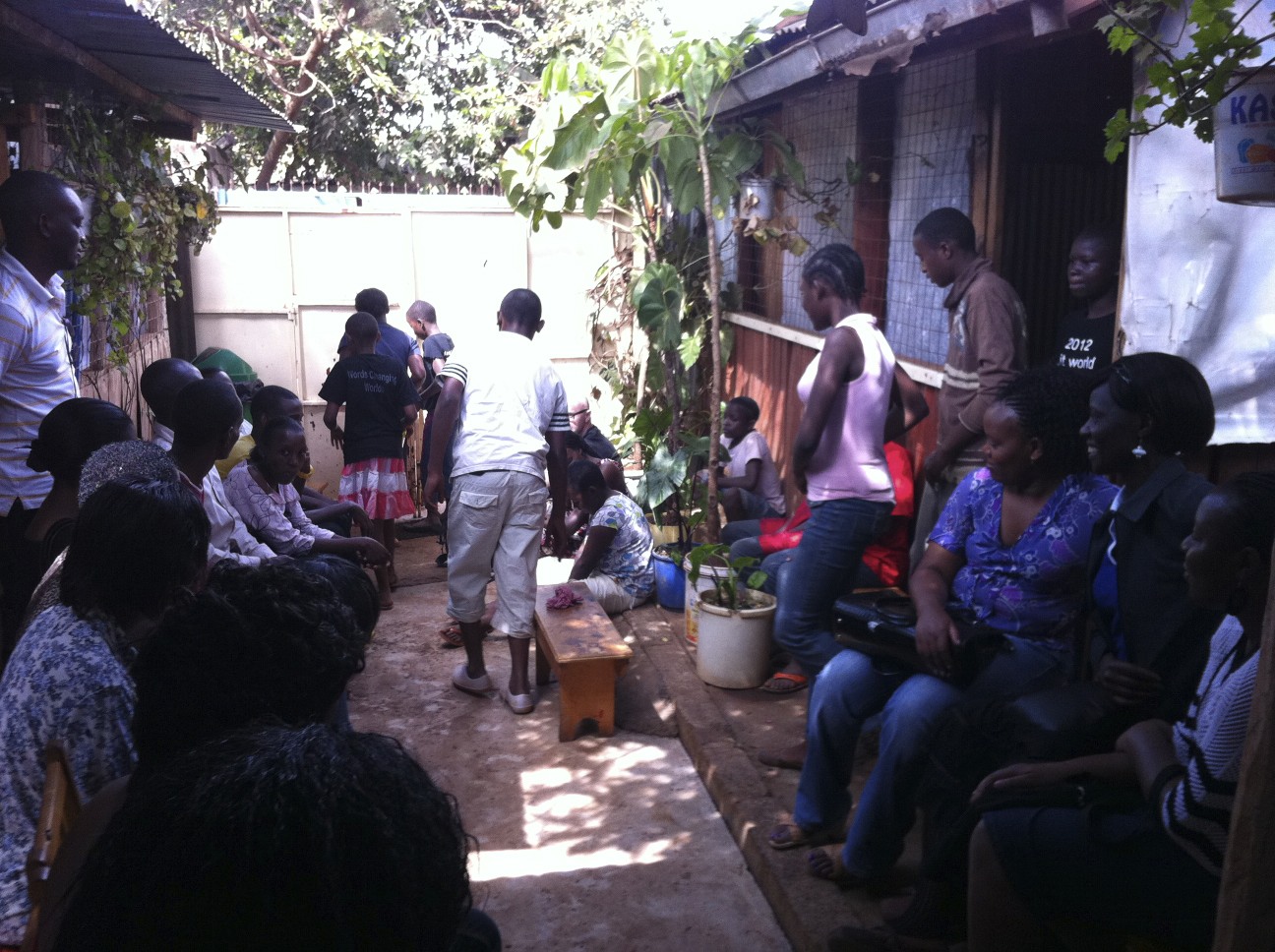
Kibera is an informal dwelling (AKA slum) within Nairobi and is said to be the largest such conglomeration in Africa.  There was a little kerfuffle as we entered the area, as local "gang members" were touting for an entry charge and banging loudly on the side of the bus for us to hand over 100 shillings (US$1.30) or so to be allowed to enter.  We managed to get through unscathed, although I must confess, my heart was pounding somewhat faster than normal at this stage.

Starting the bluebells and bamboo forest dance
Introducing each other at the home
 When we arrived at the home, Lucy, one of the fund raisers and a local primary school teacher was there with a broader than broad smile to welcome us and all the children (about a dozen of them) ran to help us unload the bus - which after the shopping spree at Uchumi, was really quite laden down.

We introduced ourselves, the kids doing the same.  Then it was play time.

Smiling faces
Most of the games and singing were quite foreign to me, but children were enjoying the company and attention.  Then came a familiar game of "In and out the dusty bluebells", where the leader starts weaving under the arched held hands and arms of the fellow players all arranged in a circle.  When the song comes to a certain phrase "I am your master" the leader skirts around the back of the person where the phrase is started and pats them on the back repeatedly then this "seconded" person joins the said master to create a conga-like train and so it goes on until there are more on the outside of the ring than those forming the ring itself.

It was lapped up by the children - and methinks, the adults too...!

[What I call the "dusty bluebells" song naturally had a local twist to it and here in Kenya it's rendered as "In and out the bamboo forest".]

Afterwards we ate lunch together, and while the food was as tasty as that which is served up at our office canteen, the thing that amazed me (and I'm not quite sure why) was the insistence on washing hands before eating.  This home was imparting simple life lessons at every stage and as Lucy, herself, said, they are trying to make proud young adults of these kids who will hopefully never feel looked down upon or inferior - even if their local MP (Raila Odinga, perhaps the next president of Kenya) should descend on them with his own youngsters.

Good manners, praying before tucking into soya stew and lentils, saying thank you with meaning and respecting elders - good life lessons indeed.

Dancing in the school yard
We saw the school the children attend and did one last dance - where even yours truly wiggled his hips to the lilting chorus of young voices - happy to just to be able to sing for us.

As we boarded the bus back to the "big bad city", the bad city didn't seem so bad after all - what we were leaving behind, on the other hand, perhaps was indeed "bad" and dangerous.  I was tremendously grateful and appreciative of that fact.

We waved good bye and promised to be back...I hope we do get back.
Holding hands

We were touched by the kids' tales of abandonment and abuse; we were humbled by their happy smiling faces and genuine hug of thanks; and we are resolved to do more for this home in the slums of Kibera.


[If you would like to help this island of hope please take a look at this link and perhaps you could donate a few dollars to make a difference..... http://www.globalgiving.org/projects/childrens-rescue-centre-kibera-kenya/ ]